
Attorney Conference Notes: A Worked Example for a Meeting with Trial Counsel
A practical guide for US attorneys to documenting conferences with trial counsel or co-counsel, with a File Note template, worked example, and checklist.
Attorney conference notes record who attended a conference with trial counsel or co-counsel, what was discussed, the strategic assessments shared, the decisions reached, and the actions each lawyer must take. A useful note separates confirmed instructions from open proposals, attributes opinions to the lawyer who offered them, and identifies deadlines that must be met.
In US legal practice, a conference with trial counsel, co-counsel, or outside litigation counsel typically follows a client meeting, a deposition, or a significant case development. The handling attorney’s attendance note — sometimes called a conference memorandum, meeting note, or File Note — preserves the substance of the professional discussion for the matter file.
This guide provides a conference-note checklist, a copyable template, and a fictional US litigation example. It is written for solo practitioners and small-firm attorneys who handle the conference and the follow-up work.
Practice point: This template is a practical starting point, not legal advice or a mandatory form. Adapt it to applicable rules, firm procedures, and the matter. “Attendance note” and “File Note” are used interchangeably throughout for the same type of professional record.
Jump to the copyable template, worked example, or frequently asked questions.
What are attorney conference notes?
Attorney conference notes are professional records of substantive discussions between lawyers working on the same matter. In litigation, these discussions commonly occur between:
- a handling attorney (the lawyer managing the case day to day) and trial counsel (a lawyer engaged for trial preparation and appearance);
- co-counsel collaborating on a shared representation; or
- the referring attorney and litigation counsel to whom the matter has been referred.
The resulting note may be called an attorney conference note, co-counsel meeting memorandum, conference with counsel note, litigation meeting note, or simply a File Note. Whatever the label, its purpose is to preserve the substance of the discussion so that both lawyers and any future reader can understand what was discussed, decided, and assigned.
Unlike a client meeting note, the conference is between professionals. Both participants may contribute legal analysis, strategic opinions, and task commitments. The note should distinguish each lawyer’s assessment, record disagreements or alternative approaches, and make clear which decisions require client authority.
For the general structure of a legal File Note, including client meetings, see what a legal File Note should include.
Why do attorney conference notes matter?
Careful conference notes serve practical purposes that become apparent when the trial date approaches, the client asks what was discussed, or the matter changes hands:
- Continuity. If either lawyer becomes unavailable, the file should explain the case strategy and the basis for decisions without requiring the absent lawyer’s recollection.
- Task accountability. Litigation conferences generate action items across two or more lawyers’ desks. A clear record prevents duplicated effort and missed deadlines.
- Strategic record. Recording the reasoning behind a trial strategy or a decision to pursue (or abandon) a particular theory preserves the professional analysis for later review.
- Client communication. The handling attorney often needs to report the substance of the conference to the client. A well-organized note provides the basis for that report without relying on memory.
- Professional responsibility. ABA Model Rule 1.1 (Competence) requires thorough preparation. Maintaining an organized file — including records of professional conferences — supports that obligation. The rule does not prescribe a note format, but the underlying duty supports diligent documentation.
- Billing support. Contemporaneous notes explain the work reflected in time entries and support the reasonableness of fees if questioned.
What should attorney conference notes include?
Adapt the following checklist to the particular conference. Not every heading applies to every discussion, and some conferences will raise issues not listed here.
1. Conference and attendance details
Record the date, start and finish times, time zone, duration, and how the conference was conducted. Identify all participants by name and role — for example, handling attorney, trial counsel, associate, paralegal, or expert. Note whether the conference was in person, by telephone, or by video, and identify any participant who joined for only part of the discussion.
2. Matter identification
Include the case caption, matter number, court and case number (if filed), and any internal file reference. This anchors the note in the matter file and makes it retrievable.
3. Purpose of the conference
State the immediate reason for the conference: trial preparation, deposition review, expert-report analysis, settlement strategy, discovery dispute, or another litigation event. Identify any deadline or hearing that prompted the conference.
4. Case status and procedural posture
Summarize the current procedural position — pending motions, discovery deadlines, the trial date, and any upcoming hearings. This provides context for the strategic discussion that follows.
5. Substantive discussion and analysis
Record the issues discussed. In a trial-preparation conference, these might include:
- Theory of the case and key themes. What is each side’s strongest argument? What narrative will trial counsel present?
- Witness assessment. Which witnesses will be called? What preparation is needed? Any concerns about credibility or availability?
- Evidence and exhibits. Exhibits to be offered or challenged, evidentiary foundation issues, and any motions in limine.
- Expert opinions. Status of expert reports, anticipated testimony, and any Daubert or Frye issues.
- Opposing counsel and party assessment. Known positions, settlement posture, and anticipated motions.
- Damages and exposure. Current assessment of damages, liability risks, and any reassessment based on recent developments.
Attribute opinions to the lawyer who expressed them. When trial counsel and the handling attorney reach different assessments, record both views and the basis for each.
6. Decisions and strategy
Distinguish settled decisions from proposals requiring further work or client authority. A recommendation to pursue a particular trial theme is not the same as an instruction to do so. Record:
- Decisions confirmed between the lawyers;
- Proposals requiring client approval;
- Alternatives considered and reasons for selecting or deferring an approach; and
- Any disagreement or reservation and how it was left.
7. Client reporting and authority
Note what the client needs to be told, whether any decision requires the client’s informed consent, and who will communicate with the client. Record any existing client instruction that constrains the discussion — for example, a settlement-authority limit.
8. Action items, responsibilities, and deadlines
Assign each task to a specific person and record its due date. Separate verified court deadlines from internal working targets. Common post-conference actions include:
- Drafting or revising a motion or brief;
- Preparing a witness for deposition or trial testimony;
- Obtaining or reviewing records or expert reports;
- Filing a motion in limine;
- Reporting to the client; and
- Scheduling the next conference.
9. Documents reviewed or to be obtained
List key documents referenced during the conference and any documents one lawyer needs to provide to the other. Note whether a document was reviewed or merely discussed.
10. Next conference or follow-up
Record the date and purpose of the next scheduled conference. If no date was set, identify the trigger — for example, “after expert reports are exchanged” or “before the pretrial conference.”
Attorney Conference Note Template
Copy the entire block below into your matter workflow. Replace the prompts with the actual conference record. Use “not discussed,” “not applicable,” or “to confirm” where accurate; do not retain the example facts from the worked example below.
ATTORNEY CONFERENCE NOTE

Matter:
Case caption:
Court / case number:
Matter number:
Conference date:
Time: [start / finish / time zone]
Duration:
Participants: [names, roles, any partial attendance]
Conference type: [in person / telephone / video; location if applicable]
Prepared by:
Preparation date and time:
Source: [contemporaneous notes / recollection / audio / transcript]
Recording / transcription: [not used, or applicable consent
details and record location]

Purpose of conference
[Immediate reason, prompting deadline or hearing]

Case status and procedural posture
[Pending motions; discovery status; trial date; upcoming hearings]

Substantive discussion
[Theory of the case; witness assessment; evidence and exhibits;
expert issues; damages and exposure; opposing-party assessment;
attribute analysis to the lawyer who offered it]

Decisions and strategy
[Confirmed decisions; proposals requiring client authority;
alternatives considered; reservations or disagreements]

Client reporting and authority
[What the client should be told; who will communicate;
existing client instructions or authority limits]

Documents reviewed or to be obtained
[Document, who has it, who needs it, by when]

Action items
| Action | Responsible person | Due date |
| ------ | ------------------ | -------- |
|        |                    |          |

Next conference or follow-up
[Date, purpose, trigger if not yet scheduled]

Matters requiring confirmation
[Issue, source to check, person responsible and review date;
distinguish court deadlines from internal targets]

Review / verification
[Sources checked; names, dates, and attribution verified;
corrections and gaps noted; reviewer and review date/time;
AI assistance if used]
Worked Example: Pre-Trial Conference with Trial Counsel
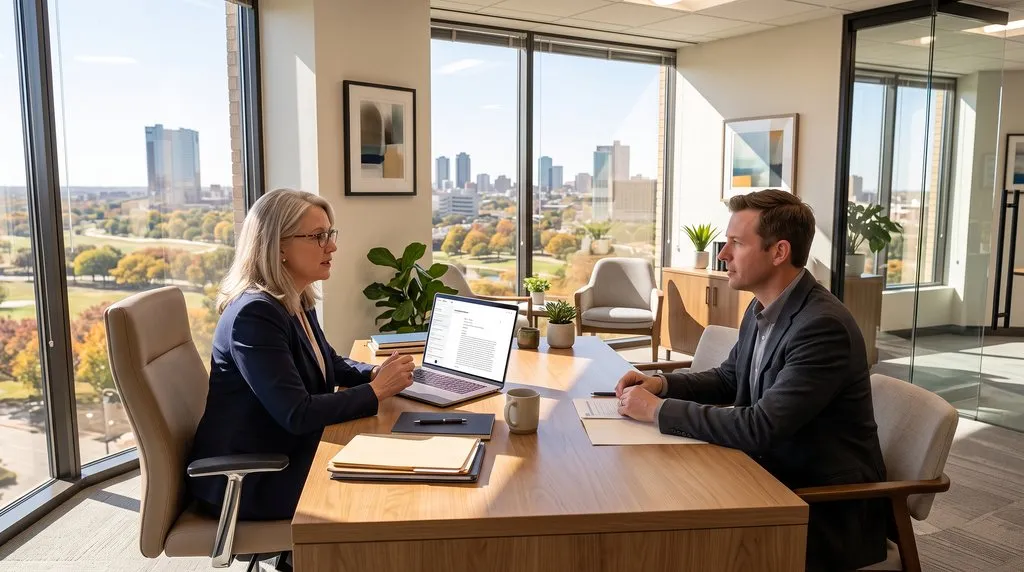
Entirely fictional: All names, facts, figures, dates, and circumstances below are invented, including the lawyers and review entries. This is a completed illustration of how to document a professional conference, not a real matter record or legal advice. The featured image does not depict these people.
File Note — Pre-Trial Conference with Trial Counsel
Matter: Rivera v. Graystone Property Management LLC — personal injury
Case caption: Maria Rivera v. Graystone Property Management LLC
Court / case number: Superior Court of California, County of Los Angeles, Case No. 26STCV04821 (fictional)
Matter number: FICTIONAL-PI-031
Conference date: October 8, 2026
Time: 2:00–3:15 p.m. PDT
Duration: 75 minutes
Participants: Carmen Reyes, handling attorney; David Park, trial counsel. No other participants attended.
Conference type: Video conference
Prepared by: Carmen Reyes, October 8, 2026, 3:45 p.m. PDT
Source: Notes taken during the conference and expanded from a post-conference dictation reviewed against those notes. No audio recording of the conference itself was made.
Purpose of conference
Pre-trial strategy conference following completion of expert discovery. Trial is set for November 16, 2026. The pretrial conference is November 6. The immediate purposes were to assess the case after receiving the defense expert’s biomechanical report, discuss witness preparation, and address a motion in limine from the defense.
Case status and procedural posture
Fact discovery closed September 15, 2026. Expert reports have been exchanged. Graystone’s motion in limine to exclude certain photographs of the stairwell condition is set for hearing on November 3. Mediation occurred July 22 but did not resolve. Trial is on the November 16 trailing calendar; the parties have been told to expect a two-day trial window.
No dispositive motions are pending. The parties have stipulated to an exhibit list deadline of November 1. Deposition designations are due November 8.
Substantive discussion
Theory of the case. David outlined the trial narrative: the client, a residential tenant, fell on a poorly maintained interior staircase. The staircase had a broken handrail, worn non-slip tread, and inadequate lighting, all of which the landlord had been notified about in writing three times over the preceding eight months. The theme is a pattern of documented neglect by a property management company that prioritized cost savings over tenant safety.
Carmen noted that the client’s written maintenance requests are strong on notice but the property manager’s responsive emails are ambiguous — they acknowledge receipt without committing to a repair timeline. David suggested framing this ambiguity as evidence of deliberate avoidance rather than responsive management.
Defense expert report. Dr. Alan Voss, the defense biomechanical expert, opined that the client’s injuries are inconsistent with the described fall mechanism. David assessed Dr. Voss’s analysis as “methodologically thin” because the report relies on a generic stairfall model rather than the specific staircase dimensions, handrail height, and tread condition documented in the plaintiff’s engineering report. David proposes cross-examining Dr. Voss on the absence of a site inspection.
Carmen confirmed that plaintiff’s expert, Dr. Lena Torres (orthopedic surgeon), reviewed Dr. Voss’s report and is prepared to testify that the injury pattern is consistent with the described fall. Dr. Torres’s supplemental declaration is due by October 15. Carmen will coordinate with Dr. Torres’s office to ensure it addresses Dr. Voss’s specific criticisms.
Witnesses. The following witness assessment was discussed:
| Witness | Role | Status | Preparation needed |
|---|---|---|---|
| Maria Rivera, client | Plaintiff | Available; needs trial preparation | David to conduct witness prep session by October 25 |
| James Ochoa, maintenance supervisor | Fact witness (plaintiff) | Subpoenaed; confirmed available | Carmen to prepare; focus on maintenance request log and response times |
| Sandra Kim, neighbor | Fact witness (plaintiff) | Confirmed available; will testify about stairwell conditions | Carmen to prepare; focus on observations, not conclusions |
| Dr. Lena Torres | Plaintiff’s expert (orthopedic) | Report filed; supplemental pending | Carmen to coordinate supplemental; David to prepare for direct |
| Dr. Alan Voss | Defense expert (biomechanical) | Report filed | David to prepare cross-examination |
| Tom Bradley, property manager | Defense witness | Expected to testify for Graystone | David to prepare cross-examination focused on maintenance response records |
Motion in limine. Graystone’s motion seeks to exclude post-incident photographs of the stairwell taken by Sandra Kim approximately two weeks after the fall, arguing the conditions may have changed. David’s assessment: the photographs are admissible because they are corroborated by the pre-incident maintenance requests and the property inspection report completed four days after the fall. David will draft the opposition. Carmen will provide the inspection-report photographs and the dated maintenance emails for comparison.
Damages. Carmen summarized the current damages assessment:
| Category | Amount | Basis |
|---|---|---|
| Past medical expenses | $87,400 | Documented bills through September 2026 |
| Future medical expenses | $35,000–$50,000 | Dr. Torres’s estimate for continued physical therapy and possible surgery; range, not a settled figure |
| Lost wages (past) | $28,500 | Employer verification letter and pay records |
| Loss of earning capacity | To be assessed | Vocational expert report expected October 12 |
| General damages | To be assessed | David to recommend range after witness preparation |
David noted that the general-damages figure will depend on the client’s presentation at trial and should not be finalized until after the witness preparation session. Both lawyers agreed that the vocational expert report may significantly affect the total demand and any revised settlement position.
Settlement. The prior mediation offer of $175,000 was rejected. David recommended reassessing the demand after the vocational report is received and witness preparation is complete, rather than reopening settlement discussions now. Carmen agreed. Any revised settlement communication requires client authority, which has not yet been sought for a new figure.
Decisions and strategy
- Trial theme confirmed: Pattern of documented neglect. David will build the opening and closing around the three unanswered maintenance requests.
- Motion in limine: David will draft the opposition brief. Due for filing by October 27 to allow time for review. Carmen will provide supporting exhibits by October 18.
- Supplemental expert declaration: Carmen will coordinate Dr. Torres’s supplemental declaration, due October 15.
- Witness preparation: David will prepare the client by October 25. Carmen will prepare Ochoa and Kim.
- Settlement: No new offer until the vocational report is reviewed and the client is consulted. Any settlement communication requires client authority.
- Deposition designations: Carmen will prepare the draft. Due November 8; internal draft by November 3.
Client reporting and authority
Carmen will report the substance of this conference to the client by October 10. The report will cover the trial theme, defense expert assessment, witness preparation schedule, and the recommendation to defer settlement discussions until after the vocational report. No decision requiring the client’s informed consent was made at this conference, but settlement authority will need to be discussed once the vocational report is available. The client’s existing settlement authority is limited to the figure discussed at mediation.
Documents reviewed or to be obtained
| Document | Status | Action |
|---|---|---|
| Defense expert report (Dr. Voss) | Reviewed during conference | David to use for cross-examination prep |
| Plaintiff’s expert report (Dr. Torres) | Reviewed during conference | Carmen to coordinate supplemental by October 15 |
| Post-incident stairwell photographs (Kim) | Discussed; copies with Carmen | Carmen to provide to David with inspection-report photos by October 18 |
| Maintenance request emails (3) | Discussed; copies in file | Carmen to organize chronologically for trial binder |
| Vocational expert report | Expected October 12 | Carmen to circulate upon receipt |
| Property inspection report | Discussed; copy in file | Carmen to provide dated photographs to David |
Action items
| Action | Responsible person | Due date |
|---|---|---|
| Report conference substance to client | Carmen | October 10, 2026 |
| Coordinate Dr. Torres supplemental declaration | Carmen | October 15, 2026 |
| Provide inspection-report photographs and maintenance emails to David | Carmen | October 18, 2026 |
| Conduct client witness preparation session | David | October 25, 2026 |
| Prepare James Ochoa for trial testimony | Carmen | October 25, 2026 |
| Prepare Sandra Kim for trial testimony | Carmen | October 25, 2026 |
| Draft opposition to motion in limine | David | October 27, 2026 |
| File exhibit list (stipulated deadline) | Carmen | November 1, 2026 |
| Prepare draft deposition designations | Carmen | November 3, 2026 |
| Pretrial conference | Both | November 6, 2026 |
| File deposition designations (deadline) | Carmen | November 8, 2026 |
| Trial | Both | November 16, 2026 (trailing calendar) |
Matters requiring confirmation
The vocational expert report is expected October 12 but has not been received. Carmen will follow up if it is not received by October 14. The trial date is on a trailing calendar; Carmen will confirm the assigned date after the pretrial conference. Deadline dates in the action items reflect the information available at the time of this conference.
Next conference
Scheduled for October 20, 2026, by video, to review the vocational expert report, finalize the motion-in-limine opposition, and discuss witness preparation progress. Carmen will circulate the vocational report and any updated damages analysis before the conference.
Review / verification
Within this fictional scenario, Carmen compared the expanded note with her conference notes at 4:10 p.m. PDT on October 8, 2026. Participant names, dates, dollar amounts, and task assignments were checked. The vocational expert report and Dr. Torres’s supplemental declaration remain outstanding; their absence is noted rather than assumed. The original conference notes and this expanded note are retained together in the fictional matter file.
What makes a good attorney conference note?
A good conference note is accurate, specific, and useful to any lawyer who needs to pick up the file. Before finalizing it, check:
- Attribution: Identify which lawyer expressed each opinion or assessment. Do not attribute trial counsel’s analysis to the handling attorney, or vice versa.
- Decisions versus proposals: Distinguish what was decided from what was recommended, what requires client authority, and what remains open.
- Accuracy: Verify names, dates, dollar amounts, case numbers, and deadlines against available sources.
- Timing: Record when the note was prepared and identify any later amendment.
- Action ownership: Every task should have a named responsible person and a due date. Distinguish court deadlines from internal targets.
- Completeness: Record material topics discussed, including topics on which no decision was reached or on which the lawyers disagreed.
- Objectivity: Note professional disagreements and the reasoning behind each position rather than presenting a single view as the only analysis.
- Lawyer review: Check the completed record against your conference notes and any supporting documents before relying on it.
Prepare the note promptly after the conference, while the discussion is fresh. If expanding or correcting it later, identify when and why the change was made. Where useful, a lawyer can dictate a post-conference account while the discussion is fresh, then verify the resulting draft.
How is a conference note different from a client meeting note?
Both are File Notes, but the participants and content differ.
| Attorney conference note | Client meeting note | |
|---|---|---|
| Participants | Lawyers working on the same matter | Lawyer and client (possibly with others) |
| Content emphasis | Legal analysis, strategy, case assessment, task allocation between lawyers | Client instructions, facts reported, advice given, client decisions |
| Client authority | Records what requires client approval but does not itself obtain it | Records the client’s instructions and informed consent |
| Privilege considerations | May be protected as attorney work product; consider work-product doctrine | Attorney-client privilege applies to confidential client communications |
| Typical follow-up | Task execution by each lawyer; client report by the handling attorney | Correspondence, filings, or further investigation based on client instructions |
For the general structure of a client meeting note, see what a legal File Note should include. For practice-area examples, see the family law File Note template and the estate-planning File Note example.
Should lawyers record conferences with counsel?
Recording a conference between lawyers raises separate considerations from recording a client meeting:
- Consent requirements. Federal wiretapping law, 18 U.S.C. § 2511, and state recording laws apply. In all-party-consent states, every participant must consent. Recording a co-counsel conference without the other lawyer’s knowledge creates professional and legal risk even in one-party-consent jurisdictions.
- Professional courtesy. Recording a colleague’s candid case assessment without notice is likely to damage the working relationship and may raise professional-conduct concerns depending on the circumstances.
- Work-product considerations. A recording of strategic analysis may create discoverable material if not properly protected. Consider whether a written note better serves confidentiality than a verbatim audio record.
- Practical alternative. Many attorneys prefer to take notes during the conference and then dictate a structured account immediately afterward, rather than recording the conference itself. The dictation captures the substance without the consent and work-product issues that recording introduces.
The decision is matter-specific and should account for applicable recording laws, professional obligations, and the working relationship between the lawyers involved. See can lawyers use AI to record client meetings for a broader discussion of recording considerations, including consent and ethical obligations.
Using AI to draft attorney conference notes
AI can help produce a structured draft from an appropriate source — whether that source is a recording made with proper consent, or a post-conference dictation by the handling attorney. Practical uses include:
- Transcription: Converting a post-conference dictation or an authorized recording into text.
- Structuring a draft note: Organizing the transcribed content under headings — discussion topics, decisions, action items, and follow-up.
- Identifying action items: Extracting tasks, assigned persons, and deadlines from the discussion.
- Reducing administrative time: Providing a structured starting point for the lawyer to review rather than typing the note from scratch.
Every AI-generated output remains a draft. The reviewing lawyer must check that:
- Strategic assessments are attributed to the correct lawyer;
- Proposals have not become confirmed decisions;
- Dollar amounts, dates, and case references are accurate;
- Action items reflect what was actually agreed, not what the AI inferred; and
- Confidential or work-product-sensitive language is appropriate for the file.
The ABA’s discussion of Formal Opinion 512 addresses competence, confidentiality, and communication when using generative AI in legal practice. ABA guidance is not itself binding law in every state, but it provides a useful framework for evaluating AI-assisted drafting. Our explanation of why a lawyer must review AI File Notes covers the review stage in detail.
How LexVoda can help
A conference with trial counsel or co-counsel often lasts 30 minutes to an hour or more. By the time the conference ends, the handling attorney has a list of action items, a strategy to report to the client, and a note to write — often alongside other matters pressing for attention.
LexVoda’s workflow is designed for exactly this situation: dictate or record → on-device transcription → structured draft File Note → lawyer review and editing → export.
After a conference, the handling attorney can open LexVoda on their iPhone, iPad, or Mac and dictate a structured account of the discussion while it is fresh. LexVoda transcribes the dictation on-device and generates a structured draft File Note — organized under headings like those in the template above — without uploading the audio to a cloud AI service.
The practical benefit for conference notes:
- Dictate immediately. Capture the discussion’s substance in a two-to-three-minute post-conference dictation rather than relying on memory hours later.
- On-device processing. Transcription and AI drafting happen locally on the device. The conference discussion — which may include privileged strategy and work product — is not sent to a cloud AI service for processing.
- Structured starting point. The AI draft organizes the dictation into a File Note structure. The lawyer reviews, corrects attribution, verifies deadlines, and edits the draft into a reliable matter record.
- Matter organization. File the conference note within LexVoda’s matter workspace alongside client meeting notes, deposition summaries, and other matter records.
- Standard exports. Export the reviewed note as PDF, RTF, or TXT for the firm’s document management system, case file, or co-counsel.
LexVoda’s core transcription and AI drafting run on-device, as explained in LexVoda’s on-device AI approach. This describes where those processing steps happen; it does not guarantee accuracy, confidentiality, or legal compliance. Device access, backups, and later sharing or exports still need attention.
Turn your iPhone, iPad, or Mac into your legal File Note workflow with LexVoda.
Download LexVoda from the Apple App Store and start your first five matters free. Dictate a post-conference account, review the AI-drafted File Note, and export it into your matter file.
Explore LexVoda’s features and device requirements, compare plans and pricing, and use the legal File Note checklist to guide your review.
This article provides general information for US legal practices. It is not legal advice and does not replace advice tailored to a particular matter or jurisdiction. Lawyers should evaluate recording, confidentiality, privilege, work-product protection, and technology requirements under the rules applicable to their jurisdiction and firm.
Frequently Asked Questions
What should attorney conference notes include?
Include the conference details, participants, matter identification, case status, substantive discussion, decisions, proposals requiring client authority, action items with deadlines, and documents reviewed or needed. Attribute analysis to the lawyer who offered it and distinguish confirmed decisions from open proposals.
What is the difference between conference notes and client meeting notes?
Conference notes record a professional discussion between lawyers working on the same matter. Client meeting notes record a discussion between a lawyer and the client. Both are File Notes, but the content emphasis differs — conference notes focus on legal analysis, strategy, and task allocation, while client meeting notes focus on instructions, advice, and client decisions.
Should I record a conference with trial counsel?
Recording raises consent, professional-courtesy, and work-product considerations. Many attorneys prefer to take notes during the conference and dictate a structured account immediately afterward. If you do record, check applicable federal and state recording laws and obtain the other lawyer’s consent.
How soon should I prepare the conference note?
Promptly — ideally the same day. The details of strategic analysis, dollar amounts, and task assignments fade quickly. Dictating a post-conference account immediately after the discussion, then verifying the resulting draft, is a practical way to preserve accuracy.
Can AI create a conference note from a post-meeting dictation?
Yes. AI can transcribe the dictation and organize it into a structured draft. The lawyer must review the draft for accurate attribution, verify that proposals are not stated as decisions, check dates and figures, and ensure the note reflects what was actually discussed.
Does LexVoda process conference notes on-device?
Yes. LexVoda performs transcription and AI File Note drafting on your device. The dictation, transcript, and draft File Note are not uploaded to a LexVoda-operated cloud AI service during those processing steps.
What format should attorney conference notes follow?
There is no single required format. The template in this article provides a practical structure. Adapt it to your firm’s procedures, the matter, and applicable professional requirements.
How long should a conference note be?
Long enough to preserve the material discussion, strategic analysis, and action items. A 75-minute trial-preparation conference may warrant two to three pages; a brief scheduling call may need only a paragraph. Focus on substance rather than a target length.
Should an AI-generated conference note be reviewed by the attending lawyer?
Yes. The attending lawyer should review and verify the draft before relying on it, checking strategic attribution, dates, figures, and action items against their knowledge of the conference and any supporting notes. See why AI File Notes must be reviewed by a lawyer.
Sources and Verification Date
Product documentation and legal sources checked October 11, 2026.
- LexVoda Privacy Policy and Terms of Use.
- LexVoda features and device requirements.
- LexVoda plans and pricing.
- ABA Model Rule 1.1 — Competence.
- ABA Formal Opinion 512 (July 29, 2024) — AI competence, confidentiality, communication, and supervision.
- 18 U.S.C. § 2511 — Federal Wiretap Act.
- What should a legal File Note include.
- Why AI File Notes must be reviewed by a lawyer.
- Why LexVoda runs AI entirely on-device.
- Can lawyers use AI to record client meetings.
- How to dictate legal File Notes after client meetings.
- Family law File Note template.
- Legal File Note example — estate planning.